Neocortex User Webinar Series

March 5, March 26, April 23, 2026

Image of Cerebras machine

The Neocortex User Webinar Series highlights real user projects, stories, and research running on Neocortex. The goals of the series are to:

  • Showcase successful Neocortex use cases and workflows
  • Foster community engagement among current and prospective users
  • Inspire broader and more effective usage of Neocortex
  • Set realistic expectations by focusing on what has been shown to work well on the CS‑3 system
Next Webinar:
Sampling- and Estimation-based Strategies for Data Collection in Wafer-Scale Evolution Simulations
March 5, 2026 – 2:00PM ET
Matthew Andres Moreno, University of Michigan

March 26, 2:00PM ET – Details forthcoming

April 23, 2:00PM ET – Details forthcoming 

Neocortex Winter 2026 Webinar

Neocortex Winter 2026 Webinar March 4, 2026, 1:00PM EST Presented by Paola Buitrago, PSC's...

Neocortex Fall 2025 Webinar

Neocortex Fall 2025 Webinar   Presented on October 21, 2025, by Paola Buitrago, PSC's...

PSC at PEARC

PSC Staff Conduct Series of Talks, Workshops, and Discussions at National Academic HPC Conference

NSF Award Funds Successor to Successful Cyber-Training Program

$1 Million to PSC and Collaborating Institutions for Development on Next Generation Cyberinfrastructure Training Program

Spring 2025 Workshop: Accelerating AI Research and Discovery with NSF-Funded Neocortex

Spring 2025 Workshop: Accelerating AI Research and Discovery with NSF-Funded NeocortexMay 27,...

Training

Neocortex Office Hours

Wednesdays, 2-3 EST and by appointment. Learn more

Contact us

Email us at neocortex@psc.edu

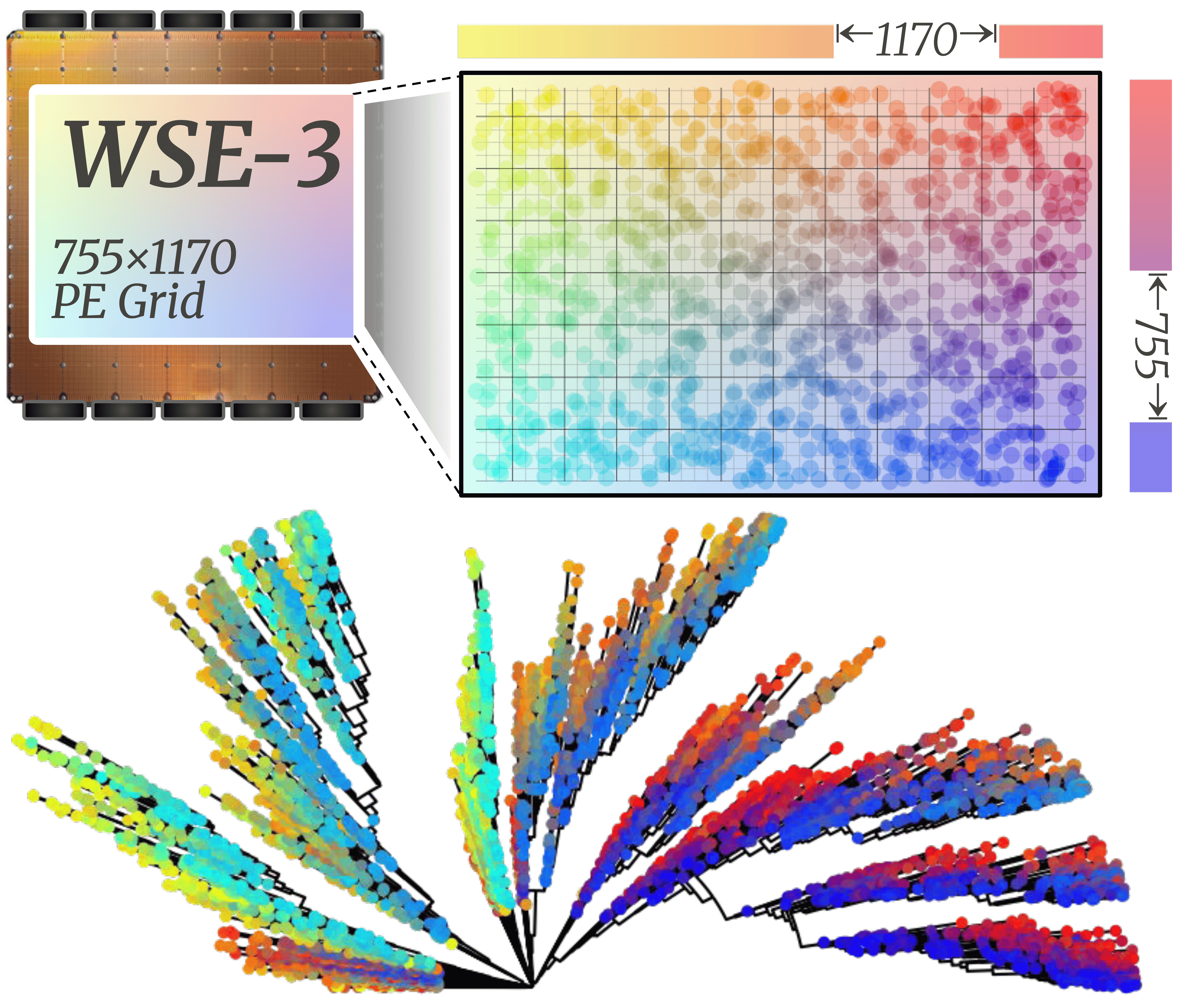
Colorful grids and plots of data
Abstract: Emerging AI/ML-oriented hardware accelerators, like the 880,000-processor Cerebras Wafer-Scale Engine (WSE), have potential to open new frontiers in computational modeling through orders-of-magnitude scale-up of high-performance computing (HPC) workloads. In the context of evolutionary biology, these technologies offer new opportunities for digital experiments exploring cross-scale biological phenomena — such as many-species eco-evolutionary dynamics and evolutionary transitions in individuality (e.g., multicellularity, eusociality). Effectively harnessing AI/ML accelerators for scientific computing workloads, however, poses substantial engineering challenges. One such challenge is tracking simulation dynamics that take place across a vast, highly-distributed fabric of memory-constrained processors. This talk will present technical and practical aspects of sampling- and estimation-based data collection strategies developed to support digital evolution on the Wafer-Scale Engine. At scale, these strategies enable the tracking of evolutionary history across trillions of simulated organisms in agent-based models. The talk will also review recent work migrating experiment and data management pipelines for general-purpose, SDK-based Wafer-Scale computing to the Cerebras Wafer-Scale Cloud.


Bio: Matthew Andres Moreno is a postdoctoral scholar at the University of Michigan, advised by Dr. Luis Zaman. His research spans evolutionary biology, high-performance computing, and artificial life, developing computational tools and methods for large-scale evolution simulations. At the University of Michigan, he is affiliated with the Ecology and Evolutionary Biology department, the Complex Systems program, and Michigan Institute for Data and AI in Society programs. He completed his graduate studies at the BEACON Center for the Study of Evolution in Action at Michigan State University, advised by Dr. Charles Ofria. He is a former Eric and Wendy Schmidt AI in Science Postdoctoral Fellow and NSF Graduate Research Fellow.

 For more information about Neocortex, explore the Neocortex project page. For questions about this webinar, please email neocortex@psc.edu.
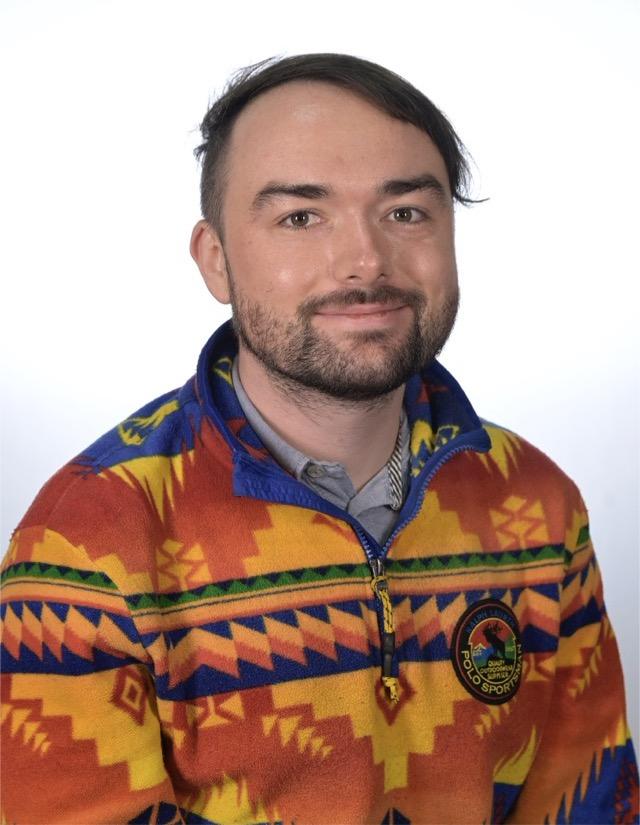
A man in a bright sweater with light skin tone and brown hair.

This material is based upon work supported by the National Science Foundation under Grant Number 2005597. Any opinions, findings, conclusions, or recommendations expressed in this material are those of the author(s) and do not necessarily reflect the views of the National Science Foundation.