
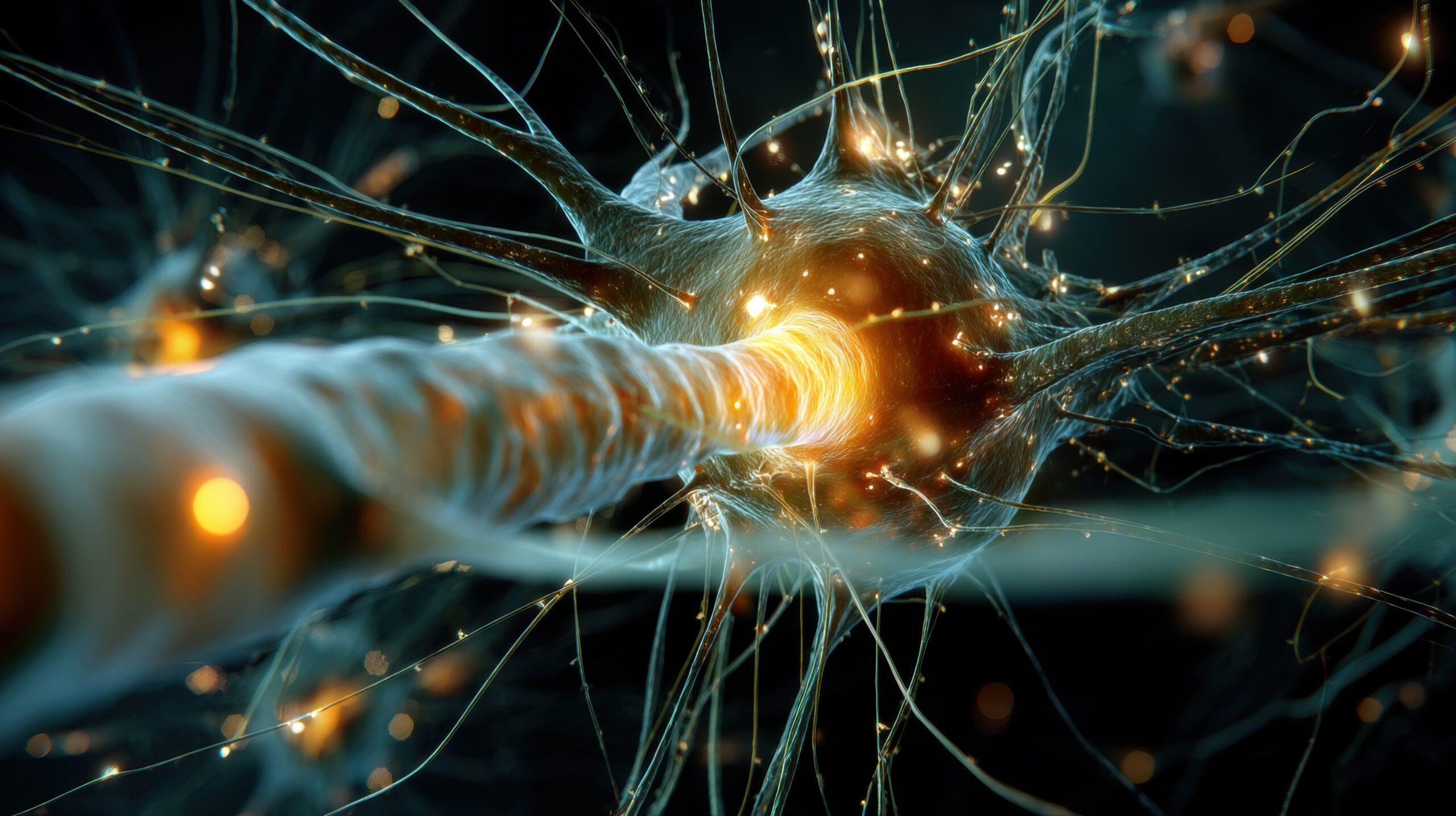
Bridges-2 Powers “Digital Twin,” Allowing Rapid Simulated Testing of Neurons
The movement of signals and nutrients down a nerve cell’s long axon is central to healthy thought and movement, and to some neurodegenerative diseases. A digital twin, a virtual nerve cell running in a computer, would allow scientists to test out ideas for treating such diseases much more quickly and inexpensively than if they were working with real nerve cells in the lab. A team from CMU used PSC’s NSF-funded Bridges-2 supercomputer to create the first example of such a digital twin. Their initial results were accurate to real life, and came much more quickly than those of previous approaches.
WHY IT’S IMPORTANT
The human nervous system is a marvel of intricate wiring. Everything we feel, think, and do depends on that wiring conveying messages at the right place and time.
But the “wires” in our nervous system are living cells, which need oxygen, nutrition, and the right surroundings to make and maintain the connections needed to carry such messages. And that’s sometimes a problem, particularly in nerve cells.
In order to work properly, these cells must carry signals and nutrients from the cell body through a long, thin, axon that branches into a network of tiny neurites to connect with other nerve cells. When this flow of material and information gets disrupted, such as in amyotrophic lateral sclerosis (ALS), these complicated connections can fail. This breaks communication between nerve cells and muscles, progressively damaging a person’s ability to move.
Doctors would like to know more about how the nerve cell’s transport system works, and how it’s derailed in disease. A detailed understanding of how the cell manages traffic in a branching neurite network could identify pinch points affected by disorders like ALS — points at which drugs could reverse the pinch and halt the disease process.
“We have been working on neurons, this kind of simulation, for almost 10 years … Most of the research in the literature [had been] on the clinical side or experimental side. Computationally, there is some imaging and image processing segmentation work. But [as for] using a mathematical model to simulate the phenomena, there were … very few papers …”
— Jessica Zhang, CMU
Tsung Yeh Hsieh, a graduate student working with CMU’s George Tallman Ladd and Florence Barrett Ladd Professor Jessica Zhang, wanted to build a virtual nerve cell to test out ideas about transport and signaling in nerve cells. A purely artificial digital twin could allow him to carry out experiments far more rapidly and less expensively than possible in real nerve cells. Such virtual neurons could allow scientists to initially test ideas for treating neurodegenerative diseases like ALS, saving the slower, more expensive wet-lab work for only the most promising avenues.
To build their digital twin, the team would turn to an allocation on PSC’s flagship Bridges-2 system from ACCESS, the NSF’s network of supercomputers.
HOW PSC HELPED
The construction of a digital twin to living neurons faced some serious hurdles. Zhang’s group had already developed physics-based computer models. But running those detailed simulations across complex 3D geometries was computationally expensive. Every 3-dimensional fork added complexity that could make the computational load soar. Hsieh realized that he needed a way of simplifying the model.
The fact that axons and neurites can be viewed as simply branching pipes offered a means to such a mathematical simplification. Hsieh and Zhang developed an autoencoder—a type of neural network model designed to compress a complicated data set into its most important features, and then reverse the process to reconstruct the complexity of the final answer.
Even with the simplifications, their autoencoder, Graph-Autoencoder-based Latent Dynamics Surrogate (GALDS), would be computationally demanding. Bridges-2 was instrumental in building and running GALDS. Its 47 powerful graphics processing unit (GPU) nodes, containing 384 GPUs, would be needed to train the AI on simulation data based on realistic nerve-cell geometries. Its 504 “regular memory” (RM) central processing unit (CPU) nodes, offering more than 64,000 computational cores, would be instrumental in running the complicated traffic in the simulations, at times requiring about 1,000 cores. And Bridges-2’s RM nodes have hefty memory compared even to other supercomputers, with 256 to 512 gigabytes of RAM for each node. This made it possible to hold the large simulation data and intermediate calculations in memory, avoiding slowdowns that could otherwise choke off the calculations.
“The computational resources [we needed for GALDS] are really high … We need about 400, 500 gigs of memory for the larger cases. So in that sense, I don’t think a personal computer can really give us that. Yeah, for our research, the support from PSC is very critical.”
— Jessica Zhang, CMU
The CMU team applied GALDS to eight neurite geometries and four examples of abnormal transport. The AI tool sped up the computations 10 times compared with earlier methods. Even better, GALDS closely matches the results of much more detailed computer simulations, with an average prediction error of about 3 percent. None of the predictions had an error of 8 percent or higher. The team reported their results in the journal Computer Methods in Applied Mechanics and Engineering in December 2025. The work also led to the AWM-SIAM Sonia Kovalevsky Lecture Prize at the Third Joint SIAM/CAIMS Annual Meeting in Montreal, Canada and the ASME Van C. Mow Medal at the ASME SB3C Summer Bioengineering Conference in Santa Ana Pueblo, New Mexico, in the summer of that year.
While GALDS represents a major advancement in creating a useful nerve cell digital twin, it has some limitations. While the autoencoder approach works at the level of general flow in the axon, it averages out minute details that might be important in some cases. Also, it models only a static neuron with a set geometry. It can’t duplicate transport in a nerve cell that’s growing and changing, which limits its ability to predict how nerve connections develop. Zhang and her team are working on avenues for autoencoders that work at different levels of detail, extending GALDS to capture changing neurite geometries, as well as integrating more detailed real-world data to further test and improve its predictions.