
Robotics Institute Team Uses Bridges-2 to Plan Warehouse Layouts, Robotic Coordination
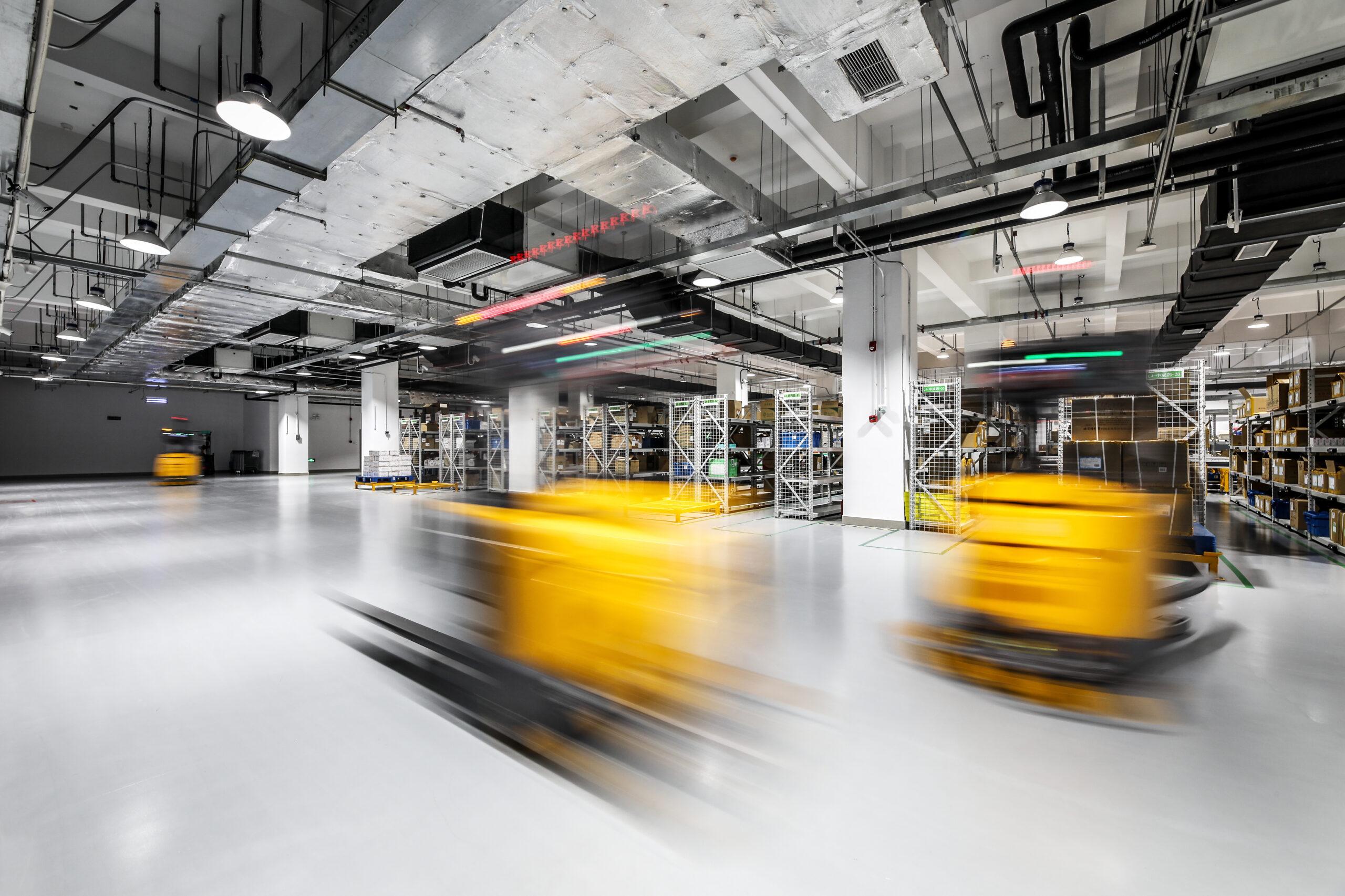
When programming warehouse robots you need to have them coordinate so they don’t get in each other’s way. Fortunately, in a warehouse you can change the environment — the layout of shelves — to make that task easier. A team at the Robotics Institute at Carnegie Mellon University has used PSC’s NSF-funded Bridges-2 supercomputer to optimize both warehouse layouts and robot coordination, improving significantly on previous methods.
WHY IT’S IMPORTANT
In 2022, Amazon reportedly had over 4,000 robots deployed in its warehouses. That number is only going to grow with time.
The whole point of these robots is to make finding, retrieving, and sending items ordered by Amazon customers as fast and reliable as possible. Which leads to a problem. A warehouse designed for humans, with regular, long rows of shelving, makes it easier for us to find and fetch the right box. But such a layout may slow down robots, which can benefit from an arrangement gauged for their strengths and weaknesses.
If you’re going to design a swarm of drones to deliver packages to apartments in a city street, the environment you have is what you have. Your robots will have to deal with it. But within a warehouse, you can change the layout to whatever you want. Which leads to a second problem. When you optimize the layout of a warehouse for robots, you can wind up with a confusing jumble that makes no sense to the human eye. It’s hard to be sure you’ve gotten the best layout possible.
“The problem we are looking at is about navigating these large team robots in a shared, very congested environment, so that they can work as efficiently as possible. And this [involved] two questions … In a warehouse, it means, for example, which shelf you’re going to reach, pick up which package, and deliver it to which workstation so that some human workers [or robot arms] can sort those packages. And then at an even higher level, where do you put these shelves, where [do] you put these packages in the shelves, and what’s the order for picking them, right? So there are multiple levels of decision-making on the task planning.”
— Jiaoyang Li, CMU
Jiaoyang Li, an assistant professor in CMU’s Robotics Institute, has led a group of scientists seeking the best way to tailor the environment so that robots can be most effective, while also meeting the needs of human planners and employees working alongside the robots. For her AI-based methods, PSC’s flagship Bridges-2, time on which she obtained via the NSF’s ACCESS network of supercomputers, has proved invaluable.
HOW PSC HELPED
Li’s team would need to use AI to solve several problems. First, they would need to find an optimum placement of racks for the robots to navigate. Second, that placement had to be understandable by humans. Finally, they had to tackle the obvious problem of making the robots navigate and work together so that they avoided traffic jams — not to mention collisions — in a way that increased overall package processing, and not just the performance of one robot.
Bridges-2 was perfect for the job. By running hundreds of simulations in parallel, the CMU team could train their AIs much faster. Each simulation would involve an AI algorithm that guessed at a solution at random. It would then test that solution, tweaking it, again at random. It would keep tweaks that improved the solution, and discard ones that didn’t. Bridges-2’s massive bank of regular memory nodes, with a total of 64,512 computing cores, allowed the group to carry out their simulations in a short amount of real time. (Compare that with 10 to 24 cores for a hot laptop computer.)
“[We] have a server in the lab, but [it] can only run very small setup experiments. Because of this parallelization requirement, I feel like for this line of research, it would be super challenging if we didn’t have a large computing center server [like Bridges-2 available].”
— Jiaoyang Li, CMU
The team’s simulations advanced both warehouse planning and robot programming. Their destination-to-chutes task mapping project charted out both inventory placement and placement of chutes that the robots would use to send packages to different destinations. This helped to increase successful package handling and decrease slowdowns due to packages having to be rerouted. Importantly, this solution scaled, meaning that it worked as well with thousands of robots as it did with hundreds. It also made sense to the human eye, giving them confidence it was a good solution.
The team also made headway in programming the robots to work together efficiently. Their Scalable Imitation Learning for Lifelong Multi-Agent Path Finding (SILLM) approach uses a relatively simple learning-based algorithm for the AI. That means that, instead of trying to map out a path from start to finish for each robot, like Google Maps’ search-based algorithm, it solves the problem step-by-step, allowing each robot to compare its location and mission to the bigger picture at each step, helping to avoid conflicts between the robots’ paths. SILLM outperformed the best alternative methods, improving on alternative learning-based methods by 137.7 percent and on search-based methods by 16 percent.
The researchers presented their work in papers at several professional conferences. Their destination-to-chutes task mapping paper was accepted by the International Symposium on Multi-Robot and Multi-Agent Systems in Singapore in December 2025. They presented their multi-agent pathfinding work at the AAAI Conference on Artificial Intelligence in February 2025 and the IEEE International Conference on Robotics and Automation in June 2025. In addition, the work earned Li an NSF Faculty Early Career Development Program Award, which “supports early-career faculty who have the potential to serve as academic role models in research and education and to lead advances in the mission of their department or organization.”