
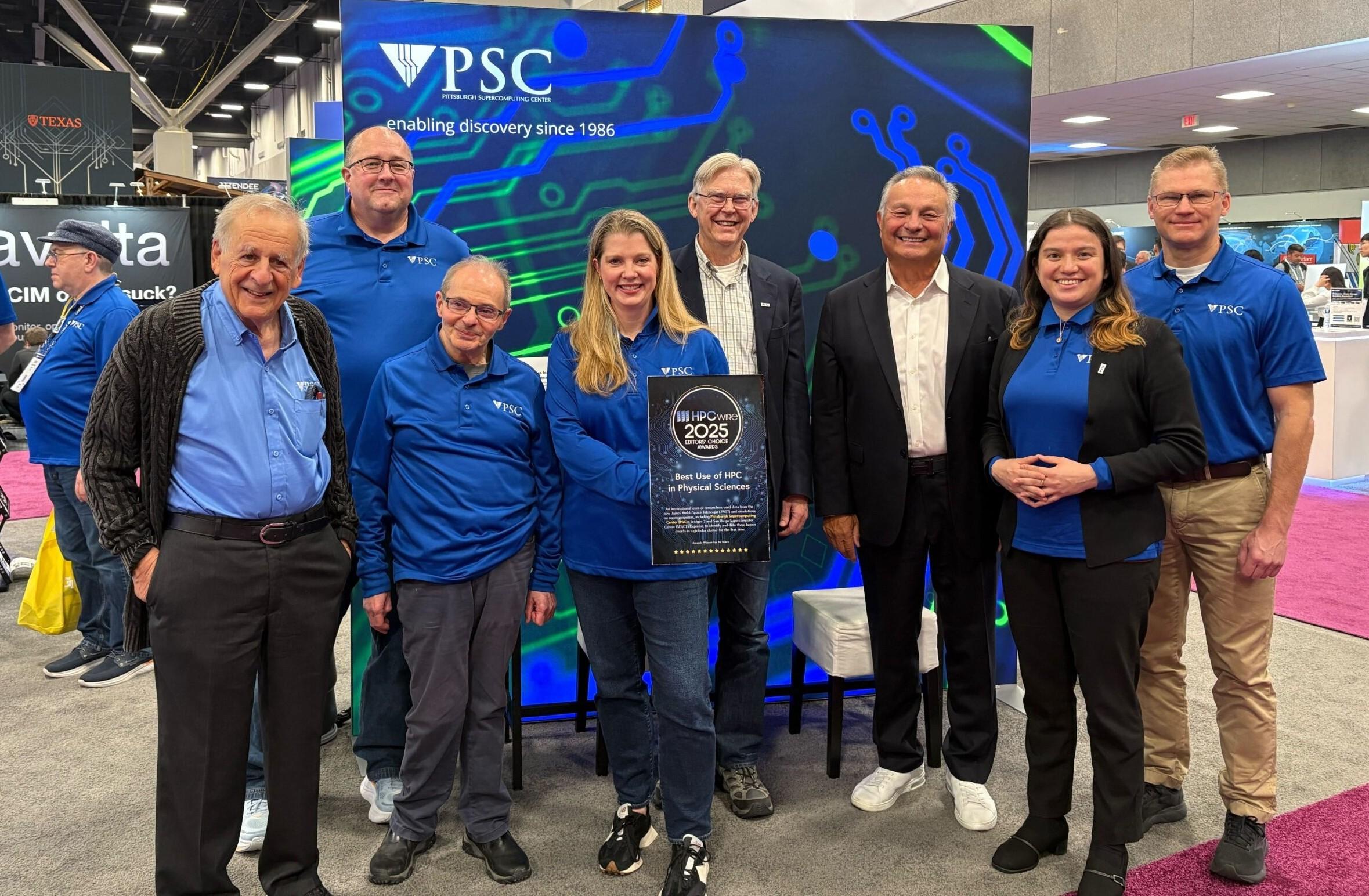
Robin and the PSC team at SC25.
Robin Scibek sat down with Chris Csonka to talk about her journey from Computer Science student at the University of Pittsburgh to Communications Director at PSC.
PSC40: Powering Discovery
2026 marks 40 years of PSC. As we continue on with cutting-edge innovation, we look back on four decades of history in computing, education, and groundbreaking research—and the people who made it happen.
SOMEWHERE TO START
CC: Robin, like many others, you started at PSC as an intern and stayed on. Were you hired by Ed [Hanna]?
RS: Kind of. Oddly enough, my first exposure to PSC was during 9/11.
CC: Really?
RS: I was a sophomore undergrad at Pitt. I was taking classes with my friend Luke Ostrosky, and was one of only two women in my comp sci classes. Most of my friends were guys—that’s just how it worked out. We were talking about our experiences during 9/11, and Luke mentioned that at work they were worried about infrastructure. I asked him what he meant and where he worked. He said, “Pittsburgh Supercomputing Center. They have a big machine room in Monroeville and they were worried it might be a target.” I don’t know if it actually was, but that was my first exposure to HPC—in the context of 9/11.
Fast forward to a year later, Luke told me his boss was looking for interns and was especially interested in hiring women. He asked if I wanted to interview. I thought, I need a summer job and real work experience. It would be much better than answering phones, which is what I was doing. If I could actually program and code, that would be fantastic!
“We were talking about our experiences during 9/11, and Luke mentioned that at work they were worried about infrastructure. I asked him what he meant and where he worked. He said, “Pittsburgh Supercomputing Center. They have a big machine room in Monroeville and they were worried it might be a target.”
PSC BEGINNINGS
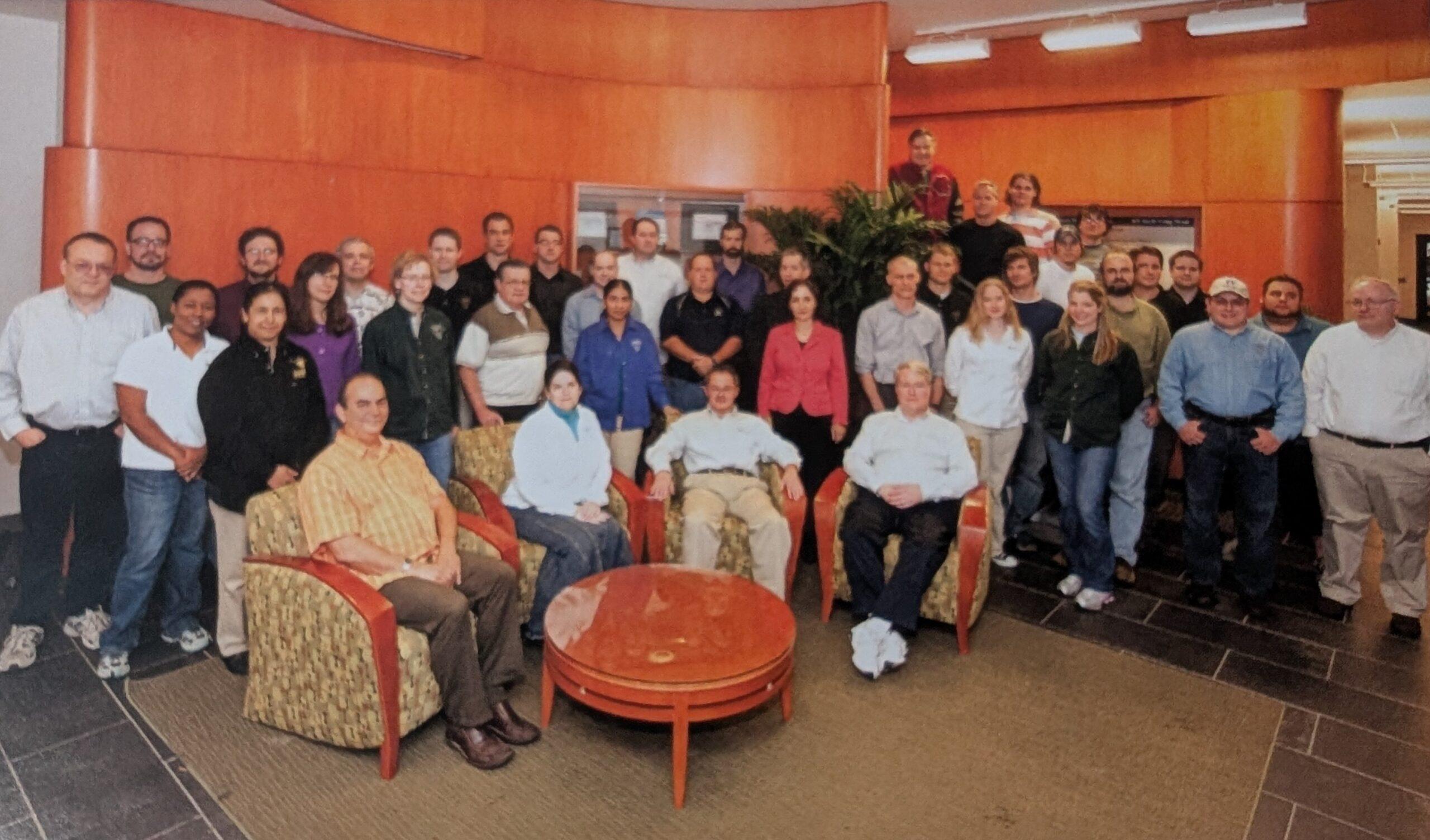
RS: Luke’s boss was Laura McGinnis, who led the DIRS group—Data and Information Resource Services. Ed and Bryan Webb were on that team. Ed was a coordinator at the time. Rob [Light] was an undergrad a year or two ahead of me and had just been hired. When I started, Laura was my hiring manager, but I worked closely with Ed. Laura wanted to rewrite our legacy allocation system—build a web interface and redesign the database. It was a major project, and I was brought on to help. Ed was one of the leads and my supervisor.
At that time we were still in Mellon Institute, sharing an office with little cubicles. Luke, a few others, and I worked in that space. It was very collegial and collaborative—and sometimes a little too much fun. At one point Luke and I even got yelled at, by Ed, for not producing enough code. So, while Ed didn’t technically hire me, he was effectively my supervisor. I’m very grateful to Laura for that opportunity because otherwise I probably wouldn’t be here.
CC: Effectively, she created a pipeline for women that might not have existed otherwise.
RS: Back then they didn’t call it “diversity,” but there were efforts to broaden participation. PSC didn’t have many women or minorities, and people recognized that.
EARLY INFLUENCES
RS: Growing up, my parents were teachers—my dad taught earth science and physics, and my mom was a special education teacher—but they never pushed me toward any particular field. And there weren’t coding toys or STEM resources like there are now, so there were fewer structured ways for kids to build those skills early.
Looking back, though, I was always drawn to the more practical, organized side of things. I played with Barbie a lot, but I also liked setting up systems and rules. When a friend down the street—who later joined the Marines—came over, we’d play “bank” with Monopoly money. He was always robbing the bank, and I was the one trying to keep it running. In hindsight, that preference for structure over chaos probably says more about my future than I realized at the time.
CC: Before cell phones or devices where kids can code, we didn’t have anything like that.
RS: Now there are toys that build those foundational skills. I have a story about Rob. He’s an incredible peer and has always known how to get things done. Whenever I would run into problems with my code, I’d ask him to look at it. Usually he’d say I was missing a semicolon or had a typo in a variable. And as you’ve probably noticed in my messages, typos are pretty common for me.
CC: Happens to the best of us, coding is very unforgiving that way.
STAFF CONNECTIONS
CC: When you were hired, do you recall anything funny or memorable at that time?
RS: Nothing like that, just the general quirkiness of the center and staff. Sometimes I’d see someone and think, why are you dressed like that? That eventually turned into my fashion “citation” notebook. And I’ve handed out plenty of citations.
CC: Oh, I remember that!
RS: Here’s how it works: things are either “out” or “back in.” One was, “Hopelessly out of date.” This was the early 2000s—things like over-the-top holiday sweaters could get you a ticket, which, by the way, are back in style now, all the rage. Other citations included “socks with sandals”—which people also wear now—and “matchy-matchy.” Steve Cunningham once wore a salmon-colored shorts-and-polo ensemble. He was definitely committed to the look. Another one was “black shoes – white socks”. Which is also back now. Apparently, PSC was just way ahead of the fashion scene at the time, and I just didn’t know! [laughs]
CC: Going back to that cohort you described, it sounds like an early example of the collaborative culture here.
RS: It really was. Once I became a staff member there was also social camaraderie. Sometimes we’d go to happy hour, and it gave us a chance to meet people from other groups—the BioMed team, networking folks. I was on the operations team then. People could cross-connect and learn what was happening across the center. It’s similar to Lunch and Learns now, where we hear about other projects—or even something fun like making a paper crane.
CC: Or learning how to be more mindful in how we address one another.
RS: Exactly. Those kinds of events are important in a workplace like this.
“Not everyone here wants to move into management—and that makes sense—but I’ve always been drawn to roles focused on people, problem‑solving, and team building. When it became clear I’d be at CMU for a while, I pursued my MBA with that direction in mind. Management was always part of how I imagined my career evolving.”
MANAGERIAL MOTIVATION
CC: Let’s switch gears. When you became a manager and started hiring, what was that like? Did you want that role?
RS: That’s a good question. Not everyone here wants to move into management—and that makes sense—but I’ve always been drawn to roles focused on people, problem‑solving, and team building. When it became clear I’d be at CMU for a while, I pursued my MBA with that direction in mind. Management was always part of how I imagined my career evolving.
CC: So you were thinking strategically.
RS: Yes, although my path has been more winding than I expected. When you’re young you think if you work hard the opportunities will come. In reality, I’ve had to advocate for almost every opportunity. That’s been both challenging and rewarding.
CC: It’s still your path. My path was different, but I’ve had a somewhat similar experience—it took me three career pivots before I became a technical writer.
PSC PATHWAYS
RS: I’ve been listening to a podcast about career paths. When you pick a major at 18, you’re choosing a subject, but you don’t yet know if you’ll like the industry or environment. There are a lot of variables.
I’m not coding anymore, but I enjoy supporting technical staff—advocating for them and building processes and structures. I’m still adjacent to that work even if it’s not my daily task. Most 18-year-olds really don’t know what they want until they try different things.
That’s one reason I’ve stayed at PSC. Even though I’ve had to advocate for some opportunities, I’ve been able to grow and shift roles—from programmer, to communications and outreach, to project management during the first Bridges install, back to communications leading our outreach and engagement team, and now more organizational leadership. Each step built on the last and helped me understand how the department operates.
CC: You bring a lot of domain knowledge to what you do—you’ve done the technical work as well as communications and management.
RS: Exactly.
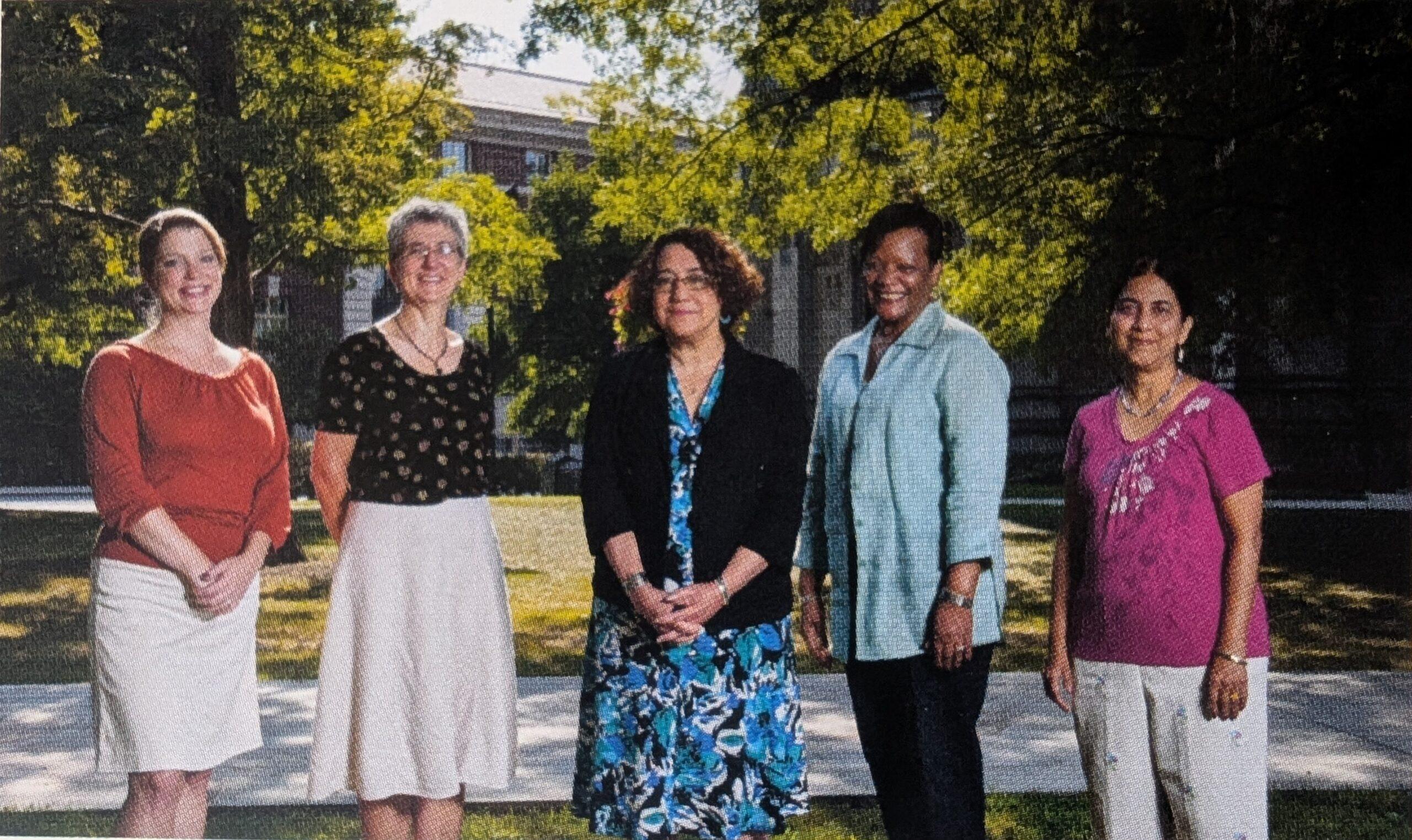
WOMEN IN HPC WORK
CC: Anything else you’d like to add about your experience at PSC?
RS: A while back Cheryl Begandy told me that in her career she essentially had to create her own path. That really resonated with me. Whether it’s the nature of this field or being a woman in technology, you have to advocate for yourself. Working hard isn’t always enough—you have to ask for opportunities and show people what you and your team are doing.
It can be frustrating, but also rewarding. I don’t want to seem ungrateful to my colleagues, but things can come differently for women. Sometimes people assume women need to be taken care of, but we can absolutely hold our own—we just need the opportunity and space.
CC: People often forget the women who did the mathematical calculations for the Apollo [space] program, or the women at Bletchley Park decoding Enigma [WWII]. Those were critical roles.
RS: Exactly. I’ve had some incredible female role models here, though some aren’t around anymore. So I lean on friends and expand my professional network. It’s not easy—but nothing worth having is.
CC: I feel that way about Deb [Nigra]. When I started here I could always ask her technical questions. Now there are moments when I think, WWDD – what would Deb do? Now I have to solve it.
RS: I often bounce ideas off Rob. He’s more reserved but deeply thoughtful, and I’ve learned—sometimes the hard way—that if I pause and stop filling the silence, his insight is always worth the wait.
CC: There are a lot of people like that here.
RS: We really do have an incredible team. That’s one reason so many people stay. In most places you don’t see 20- or 30-year careers anymore. But in an academic environment with constantly changing technology and research, things stay dynamic. Even if your title doesn’t change, the work evolves. People here wear a lot of hats—especially on our team, but across the center as well.