
Simulations on NSF-Funded Bridges-2 Supercomputer and Others Granted “Best Use of HPC in Life Sciences” and “Best Use of HPC in Physical Sciences” at 22nd Annual HPCwire Awards
Two series of simulations, one of HIV and one of brown dwarf stars, carried out by supercomputers at PSC and elsewhere, have earned HPCwire Editors’ Choice Awards. In one project, scientists from the University of Pittsburgh used PSC’s Bridges-2 system to determine how the virus that causes AIDS enters human cell nuclei. In the other, simulations and data from NASA’s James Webb Space Telescope (JWST) enabled the first identification and characterization of the failed stars in a globular cluster in our Milky Way galaxy.
Presented to leaders in the global high performance computing community at the 2025 International Conference for High Performance Computing, Networking, Storage, and Analysis (SC25), in St. Louis, Missouri, the coveted annual awards are determined through a nomination and voting process with the global HPCwire community, as well as selections from the HPCwire editors. The awards are an annual feature of the publication and constitute prestigious recognition from the HPC community. They are revealed each year to kick off the annual supercomputing conference, which showcases high performance computing, networking, storage, and data analysis.
The list of winners was revealed at the SC25 HPCwire booth, as well as on the HPCwire website: https://www.hpcwire.com/2025-hpcwire-awards-readers-editors-choice.
“This award exemplifies a core principle behind PSC’s mission,” said Barr von Oehsen, PhD, Director of PSC. “By contributing expertise and computational resources, we can support and enable research that would not have been possible without such extensive collaboration.”
The HPCwire awards, one for life sciences and one for physical sciences, recognized two projects undertaken using PSC’s flagship Bridges-2 supercomputer:
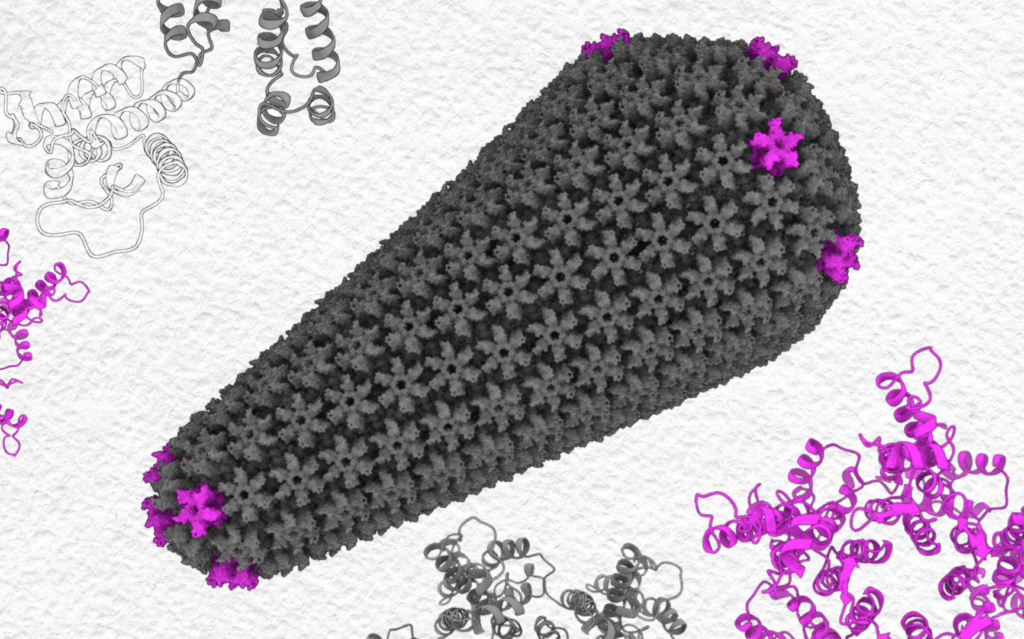
- An important step in infection by HIV is insertion of the viral capsid — the inner protein coat containing its genetic material — through the host cell’s nuclear pore. How the virus does this is a puzzle of squeezing a large structure though a small entrance. It’s also a potential target for better therapies. Simulations on Bridges-2 by a University of Pittsburgh team revealed how changes in the shape of the HIV-1 capsid protein may help the capsid be more flexible. The method may also be useful for studying flexibility in other important proteins.
- Collections of stars called globular clusters are some of the oldest known structures in our Galaxy, and their properties preserve the record of conditions in the early Universe. But estimating their exact ages is very challenging, and different dating techniques often disagree with each other. Brown dwarfs, too small to be stars and too large to be planets, cool off over time, providing a new way to estimate the age of the parent cluster. An international team used data from the JWST and simulation on supercomputers including Bridges-2 to identify and date for the first time three brown dwarfs in a globular cluster.
“While the early advances in applying AI to science and engineering are producing exciting and impressive results, traditional HPC continues to drive breakthrough discoveries for mission-critical workloads and applications,” said Tom Tabor, CEO of TCI Media, publishers of HPCwire. “The 2025 Readers’ and Editors’ Choice Awards truly capture this dynamic era of innovation.”More information on these awards can be found at the HPCwire website (www.HPCwire.com) or on X through the following hashtag: #HPCwireRCA25.