
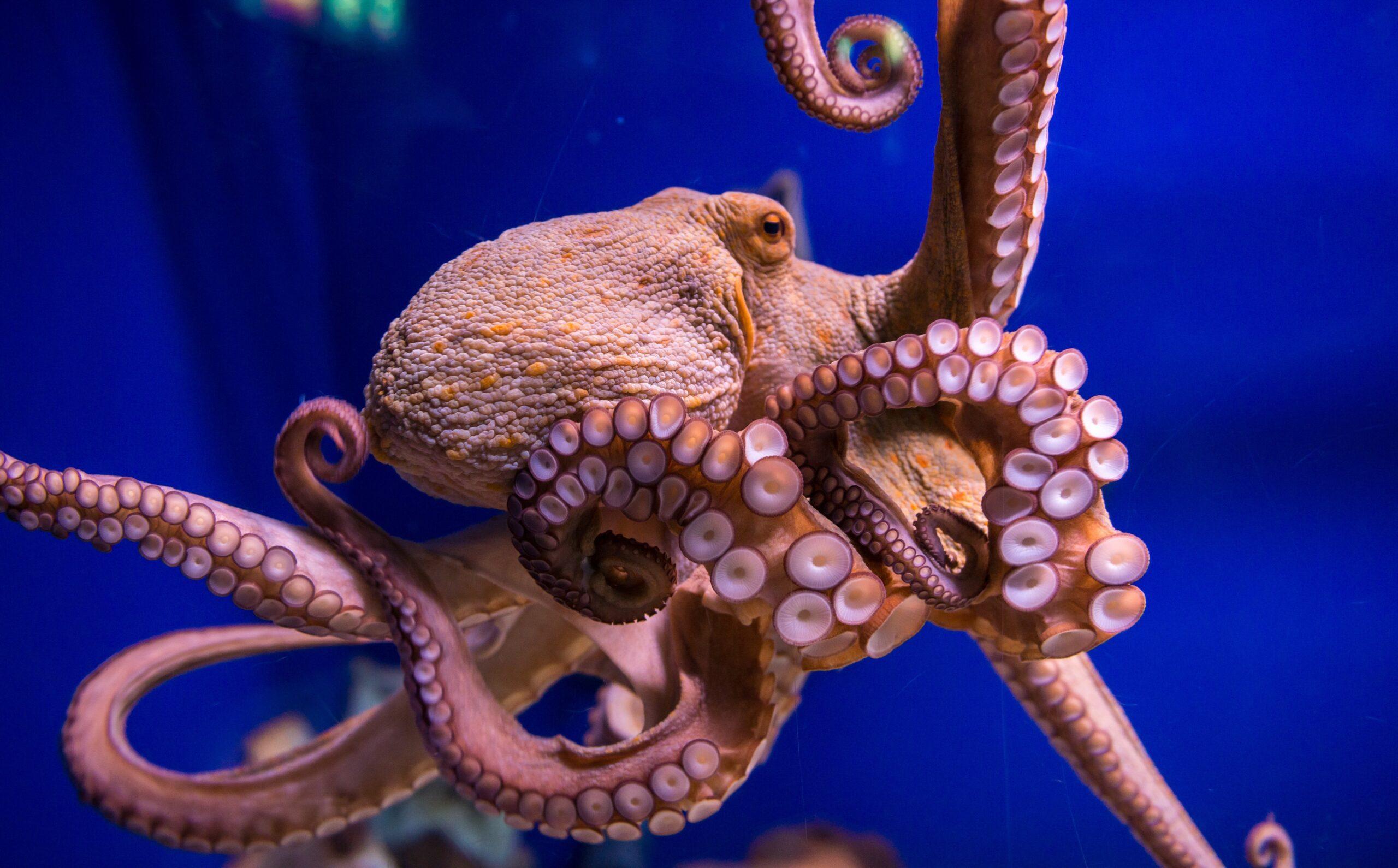
Octopuses’ arms can move in amazingly complex ways — and may be a better model than human arms for robots.
Virtual Octopus Arm Shows Complex Movements Can Be Governed by Surprisingly Simple Programming
While controlling the simple joints of a robot in human shape is relatively easy, something along the lines of an octopus arm offers a lot more flexibility of movement and versatility. The problem is how to control these complex movements. A team led from the University of Illinois used real-life experiments on octopuses and simulations of a robotic octopus limb on the NSF-funded Bridges-2 at PSC and Frontera at the Texas Advanced Computing Center (TACC) to show that the clever placement of muscles in the octopus arm makes controlling it surprisingly simple. The work offers lessons in robotics, the biology of organisms with flexible limbs, and approaches to diagnosing muscle dysfunction in humans.
WHY IT’S IMPORTANT
Human-shaped robots are a staple of sci-fi. But human arms and legs may not be the best model for robots. The limited motions of our limbs mean that, when the angle is just not right, we struggle to lift and control objects.
The octopus arm may be a better model for robotics. Since these appendages have no bones, they can move in amazingly complex — and precise — ways. And they can do this from virtually any angle or orientation.
“The octopus is kind of an iconic model for people that have been looking into soft robotics and things of the sort, because it’s completely soft, it doesn’t have any bone or anything. But the way we have been thinking about this is really from a control perspective … It’s really an open problem how to control a structure that is completely soft, that is completely distributed, where you have muscles all over the place.”
— Mattia Gazzola, University of Illinois
Octopus arms make up for their lack of bones by pairing muscles off against each other to create rigidity only when it’s needed. It allows them to transition from rigidity to movement gracefully. But it also poses a huge control problem. How do you coordinate all those muscles to move properly?
Mattia Gazzola of the University of Illinois and colleagues there and at the University of North Carolina, Chapel Hill, wanted to see if there was an overall simplicity to how octopuses move their limbs. They combined medical imaging, biomechanical data, and live behavioral experiments on octopuses with a virtual octopus arm they programmed in PSC’s flagship Bridges-2 supercomputer and Frontera at TACC. They acquired time on these systems through ACCESS, the NSF’s network of supercomputing resources, in which PSC is a leading member.
HOW PSC HELPED
The arrangement of muscle fibers in a tentacle is complicated compared with the simple pull-and-push design of human limb muscles. A nerve runs through the center of the arm. Around it lies a series of muscles that run the length of the tentacle — the longitudinal muscles. Around these muscles are a series of muscles shaped like rings around the arm — the transverse muscles equivalent. Finally, around those are a series of muscles in a diamond-shaped pattern, the oblique muscles. By tweaking these muscles differently, the arm can form just about any shape.

Computational modeling of an octopus arm from chemical, biomechanical, and MRI data. From Tekinalp A et al. Topology, dynamics, and control of a muscle-architected soft arm, Proc. Natl. Acad. Sci. U.S.A. 121 (41) e2318769121.
The question is, does this tweaking require coordination so complex that it’s not a great starting point for robot design?
The scientists’ virtual octopus arm consisted of about 200 continuous muscle groups, connected at 1,000 points. Moving back and forth between real-life experiments and tweaking the simulated limb, the scientists could work through how the octopus controls its muscles — and how a robot could copy it.
To make it all work, the team had to build a full flow structure simulation. This approach would allow their virtual tentacle to make all the movements possible for a real tentacle. But it would require massive computing power. Bridges-2 and Frontera proved critical for the work. The team’s ACCESS allocation gave them the ability to move back and forth between the two systems, so that a given computation played to each computer’s strengths. The power of each system as well gave them the ability to test ideas quickly and change their parameters to follow up on each discovery.
“[Our] full model of the octopus arm is realized by assembling together these elastic rods that are also made active, so we use biomechanical parameters from the octopus … To derive [these muscles] we have to solve an inverse problem, meaning that we need to simulate many times the behavior of the octopus so that we can figure out what is the control strategy. [We run] hundreds of [simulations] at a time, to explore all these different options, and then get a sense of … the parameters, or the functional forms that we use to control the arm.”
— Mattia Gazzola, University of Illinois
The collaborators started with a long list of possible control parameters, experimenting with what movements each could produce in the arm, and how leaving a given parameter out would affect that control. The work produced a pleasant surprise — they were able to simplify the controls so that only a small number of parameters were able to produce full movement in the virtual appendage. What the team really discovered was that the placement of the muscles in the arm did most of the heavy lifting — literally. That structure produced force in many ways that allowed the controls to be surprisingly simple.
The team published their results in the Proceedings of the National Academy of Sciences USA in October 2024. Their paper earned the prestigious cover image of that issue.
The scientists’ findings offer a “twofer” of discovery. The results suggest that the octopus arm is indeed a viable model for designing robotic arms. They also shed light on how octopuses, squids, elephants, snakes, and other animals control flexible limbs. The team’s method also offers promise in medical imaging, where it can help doctors better understand how patients’ muscles are behaving — or misbehaving.