
Bridges-2
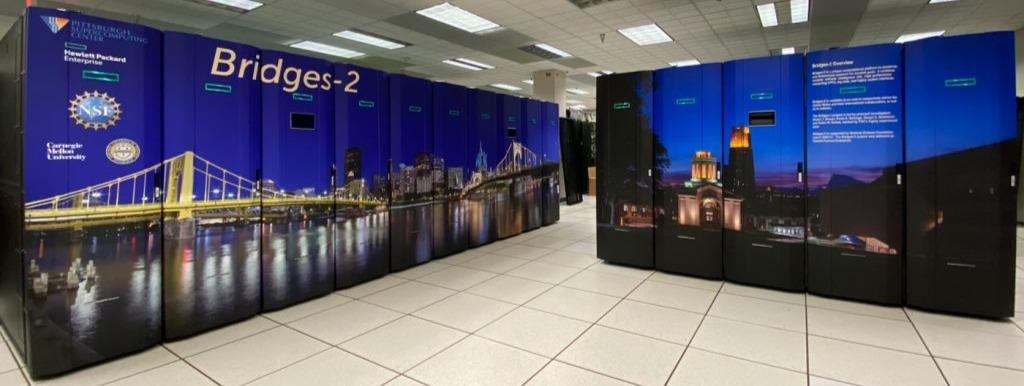
PSC received two supplemental funding grants from the National Science Foundation (NSF) extending the operation of its flagship Bridges-2 supercomputer for a total additional two years. These awards are funding the national-capacity computing resource to Sept. 30, 2027. Totaling $3,999,998, these grants support the core functions of the project, as well as datacenter costs for the additional time: power, space and network maintenance, at no cost to investigators using the system.
“We are very grateful to the NSF for enabling us to continue providing leading-edge resources to over 1500 projects across the nation, as well as to AI leadership advanced by the NAIRR program,” said Sergiu Sanielevici, Senior Scientific Advisor at PSC and PI for Bridges-2. “The research and workforce development enabled by Bridges-2 contributes to other national R&D budgetary priority areas, including quantum information science; advanced manufacturing; semiconductors and microelectronics; energy; biomanufacturing and biosecurity; food safety; health; preparedness and resilience; and ocean and polar exploration and observation.”
Bridges-2 provides transformative capability for rapidly evolving, computation-intensive, and data-intensive research, creating opportunities for collaboration and convergence research. The system integrates evolving leading-edge technologies for converged, scalable HPC, machine learning, and data to promote and enable the convergence and coupling of simulation and machine learning methods to efficiently address scientific challenges of unprecedented scope and complexity. Bridges-2 serves as a leading contributor to the NSF ACCESS and NAIRR Pilot projects.
Neocortex
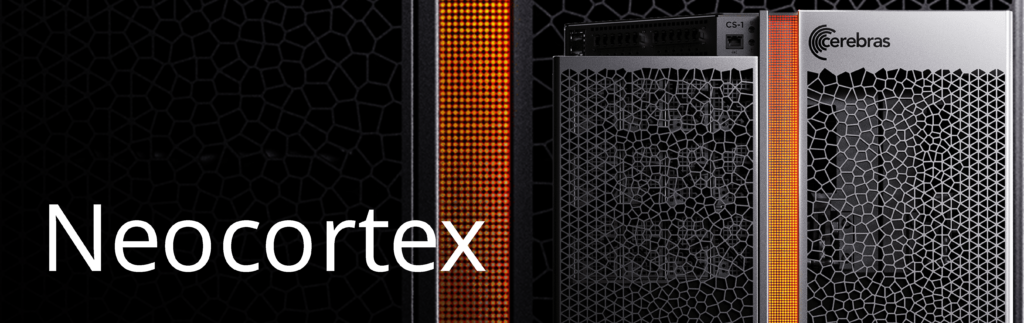
PSC also received an NSF funding grant to extend Neocortex, its innovative AI system, based on Cerebras’s Wafer Scale Engine technology and the extreme-memory HPE Superdome Flex server. The supplement, for $999,999, will extend operations for Neocortex to May 31, 2027, giving investigators affiliated with U.S. institutions access at no cost.
The WSE is an ultra powerful accelerator designed for AI that has demonstrated impressive performance for AI inference and training. The HPE Superdome Flex has a total of 24 TB of RAM, the largest memory in the NSF cyberinfrastructure ecosystem. Excellent for genomics and graph algorithms.
“Securing access and training programs to innovative tools and infrastructure for AI and computational research is critical for the prosperity of the American community,” said Paola Buitrago, PSC’s Director of AI & Big Data and Project Director and Principal Investigator for Neocortex. “We love our mission of supporting progress through advancements in science and engineering, and invite researchers to get involved!”
Neocortex is a highly innovative AI computing infrastructure testbed that accelerates AI-powered scientific discovery by vastly shortening the time required for deep learning training and inference, fosters greater integration of artificial deep learning with scientific workflows, and provides revolutionary innovative hardware for the development of more efficient algorithms for artificial intelligence and graph analytics. An innovative part of the American science and technology engine, Neocortex directly and effectively supports the Presidential Research and Development budgetary priorities and priority cross-cutting actions as established in the Presidential FY 2027 memorandum.