
Anna (left) with friends including fellow PSC intern Miriam Bamaca (right) at the time-honored Pittsburgh Picklesburgh festival.
This spring, PSC’s Chris Csonka sat down with Anna Sawford, Slippery Rock junior and PSC intern to talk about her time and experiences at the center and what her future looks like.
PSC40: Powering Discovery
2026 marks 40 years of PSC. As we continue on with cutting-edge innovation, we look back on four decades of history in computing, education, and groundbreaking research—and the people who made it happen.
CC: How did you first learn about PSC, and what made you want to work here?
AS: My uncle in Philadelphia mentioned the Pittsburgh Supercomputing Center when I was looking for internships. I’d never heard of it, but since I live near Pittsburgh, I checked the website and thought, “This looks like a job I’d really enjoy.” I kept checking for applications and emailed Valerie [Rossi] as soon as they opened.
CC: What’s your field of study?
AS: I’m majoring in computer science with a minor in writing.
CC: You worked with Valerie on Learning Lab courses. Did you work on other projects?
AS: I’m still working on the courses, but I’ve also been editing John [Urbanic]’s workshop videos—turning all the content into three‑hour YouTube videos. Each one has multiple audio and video angles plus slides, so syncing everything takes time.
CC: What software do you use?
AS: Just iMovie on my laptop. When they’re done, Valerie and I upload them to our learning management system.
CC: Have you worked with others at PSC?
AS: I’ve collaborated with other interns, and with Emily Voelker on course widgets and related features. I’ve also worked closely with Miriam on the courses over the summer.
CC: What’s your biggest takeaway from PSC?
I’ve learned so much about supercomputing—I knew nothing at first. Working on courses and conferences helped me realize I want a job that includes teaching. I also learned a lot about time management, since I work another job during school.
CC: What’s your other job?
AS: I’m a community assistant—also known as a resident assistant—at Slippery Rock.
CC: That must keep you busy. An interest in both computers and writing, that’s kind of a unique skill set. That must give you an advantage over others in the field?
AS: Definitely. Some experts are so knowledgeable that it’s hard to follow them. I’ve also had that experience with some professors. The writing factor came into play even when watching the videos. When Miriam and I were recreating the courses, we learned everything by watching those videos. I also needed to do additional research just to be able to convey the concepts to others in a way that anyone can understand, not just those experienced in the topics.
CC: What’s that old saying? If you want to learn something, teach it? What’s next for you after this internship?
AS: My PSC internship ends May 14, and on May 26 I start a new internship at MS Consultants, an engineering firm. I’ll be helping with technology improvements and some cybersecurity work.
CC: When do you graduate?
AS: May 2027. I’m a junior now.
CC: Where do you see yourself in five years?
AS: Working in the computing industry. I’d love to return to PSC if there’s an opportunity—I love the environment and the people. Long‑term, I’d like to pursue a master’s or PhD and eventually become a professor, but I want industry experience first.
CC: Would writing still interest you?
AS: Absolutely. I love writing! I’m in a fiction class now and enjoy it, but I’d like to focus on technical writing.
CC: You did well with the course content. At PSC, a lot of the technical writing tends to be process-oriented, or like the course content you worked on.
AS: Thank you. That kind of writing is interesting to me, too.
CC: I’ve been doing a lot of these feature articles and interviews lately. I find it way more creative, and very rewarding, personally. Interviews can go in unexpected directions.
AS: They really can.
CC: I interviewed PSC founders Mike Levine and Ralph Roskies. Ralph’s interview was exactly as expected—full of great stories. Mike’s ran nearly three hours! More fantastic stories, but very “stream‑of‑consciousness.” It’s a massive trove of content to sift through.
AS: I can’t imagine doing a three‑hour interview!
CC: We recorded it in person with a mic and camera setup. Normally, I just schedule a call and record everything, that way nothing is missed.
AS: I also often use transcripts for the videos I edit.
CC: Anything else you’d like to share about your time at PSC?
AS: My summer experience was wonderful. At first I was nervous—during the initial Zoom call with all 50 interns, I realized I was the only Slippery Rock student. But once I arrived, got to room with Miriam, and met everyone, I felt completely comfortable. The program was welcoming, and I never had a bad interaction with anyone.
I’d tell anyone considering the internship to apply. Weekends were filled with activities: exploring the city, hiking, even whitewater rafting. It wasn’t just a job; it was a community. Living downtown for the summer was amazing.
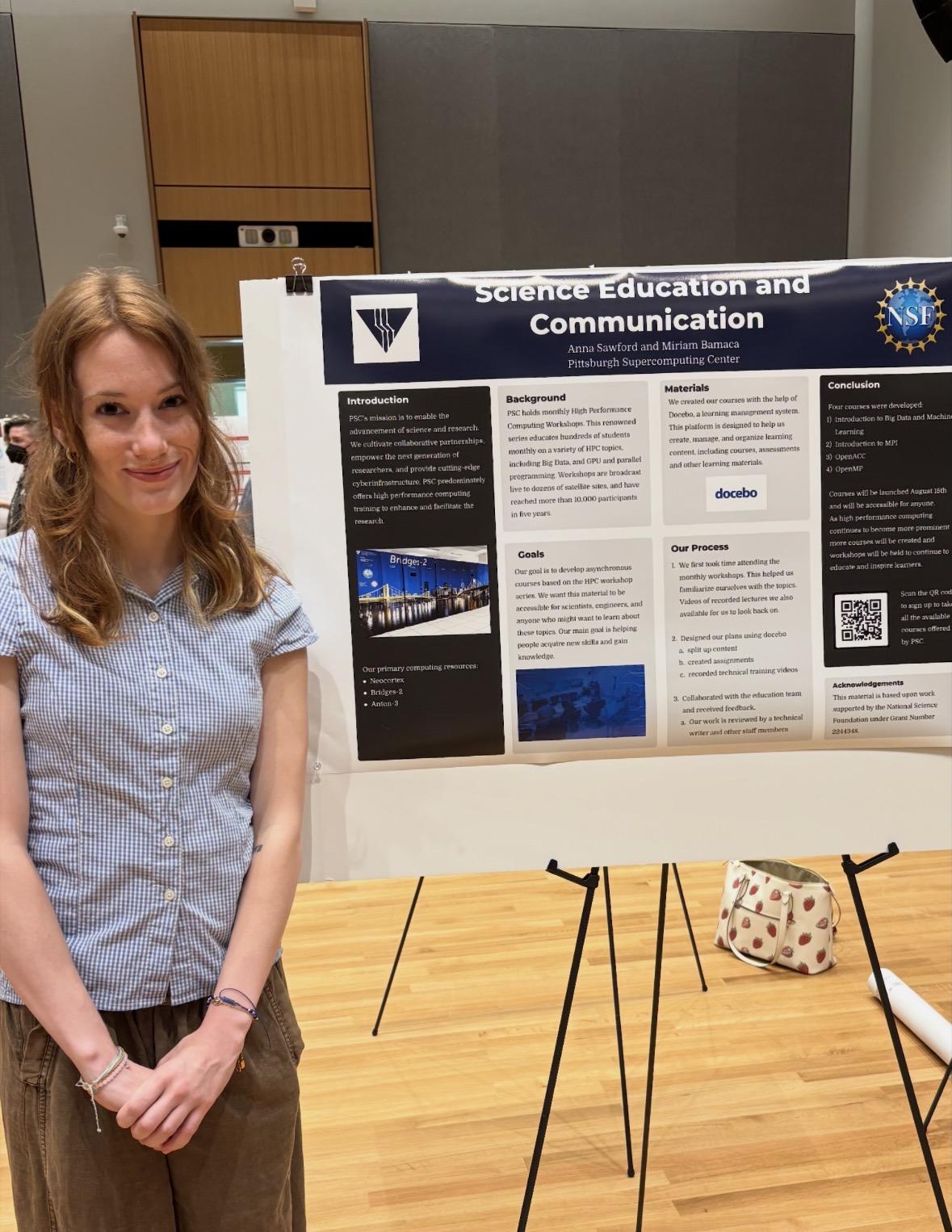
CC: You also did a poster session, right?
Yes, and I recently presented at a conference at Slippery Rock, Cyberspace. Thanks to the speaking experience I gained at PSC, I felt much more confident. Our group presented on quantum neuro‑cryptanalysis. Crypto analysis is about hiding data. We simulated quantum computing to see if it improved deciphering details from random noise, and it did, significantly. So, our prediction was right and then we had to submit a poster on that, too.
CC: That’s fascinating.
AS: I didn’t know much about quantum computing before, either, but PSC has a course on it, which helped.
CC: Thanks for taking the time to talk.
AS: I’m glad to be part of this.