

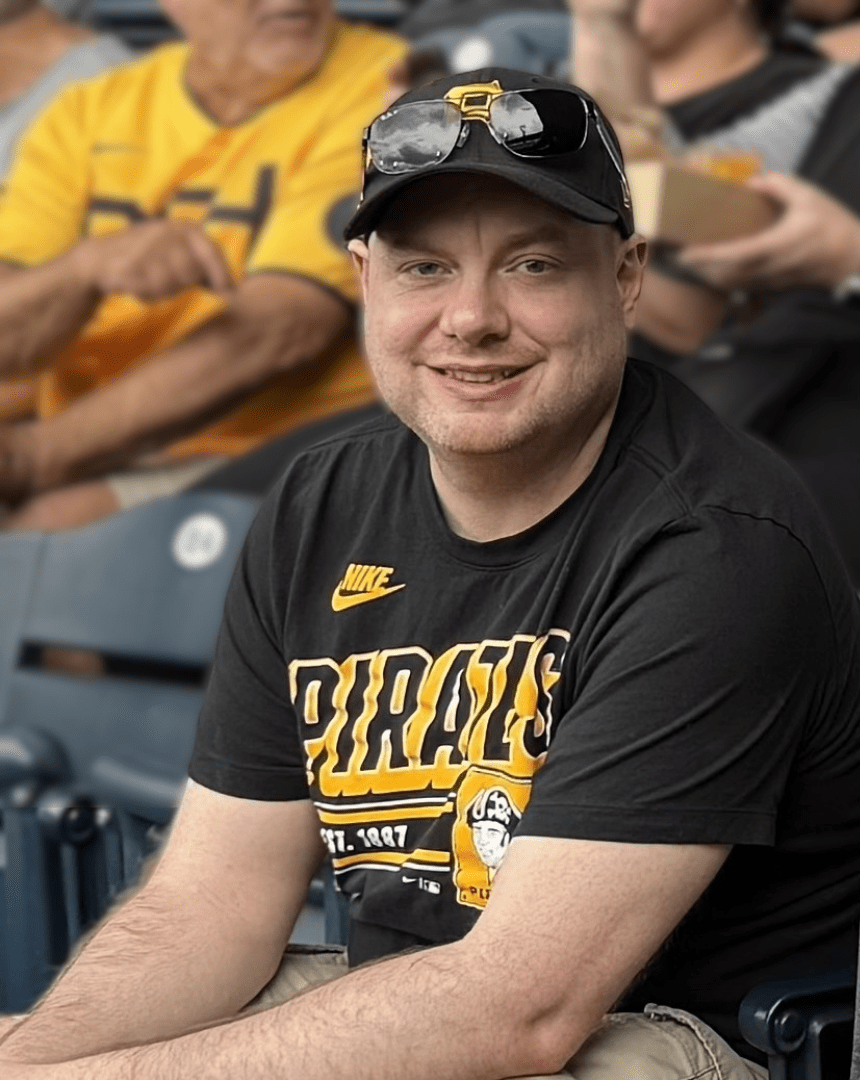
Rob Light, now PSC’s Principal Systems Software Engineer Manager, who started in 1999 as a student.
PSC’s Chris Csonka sat down with Rob Light, Principal Systems Software Engineer Manager to chat about Rob’s time at PSC from his beginning days to the present.
PSC40: Powering Discovery
2026 marks 40 years of PSC. As we continue on with cutting-edge innovation, we look back on four decades of history in computing, education, and groundbreaking research—and the people who made it happen.
CC: Rob, thanks for sitting down with me for this interview. Let’s kick this off by talking about when you started at PSC.
RL: That was my sophomore year at [University of] Pittsburgh, January 1999.
CC: Were you hired on by Ed Hanna?
RL: It was Ed and Laura McGinnis, they were kind of working together at the time.
CC: Were you hired into a specific role? As an intern?
RL: It wasn’t technically an internship, but it was the student program at the time. They were running the allocations development team working on the allocation system and the accounting system. Things like that.
CC: Those are the kind of things you did when you were first hired? I don’t know a lot about what you do at PSC. Is your role still similar to when you started?
RL: I still do a lot of the allocations and accounting stuff. We do a lot of that with ACCESS, the nationwide allocations and accounting. [Software] development, that’s mostly still what I’m doing and you know, I’m the software engineering manager as well. Matt [Yoder] and Burt [Cubbinson] also do a lot of allocations and accounting.
CC: So when you started, it was mostly just allocations here at the PSC. Now it’s expanded with ACCESS to more of a nationwide scale?
RL: Yes. You know previously each center had to do their own. And early on when I started full time we started integrating with TeraGrid. That was the first program that started it all with allocations and things nationally.
CC: One of the first nationally? There was also XSEDE that preceded ACCESS.
RL: Yeah, that’s been the history. [Tera]Grid to XSEDE to ACCESS.
CC: Do you have any stories about when you were starting out?
RL: One story I remember because back then the database system was pretty fragile.
So, I was working on something and, at the time, I didn’t know how to use VI, [a text editor], at all. Ed had taught me Emacs, so I knew that, but somehow I got into VI and I used the keystrokes to exit Emacs, but since I was in VI, my screen just started spinning, like all the text, and it eventually crashed the entire database server!
Then everyone panicked, hoping that it would come back up. I was sure I was going to get fired.
Thankfully, it all worked out and the system had backed everything up.
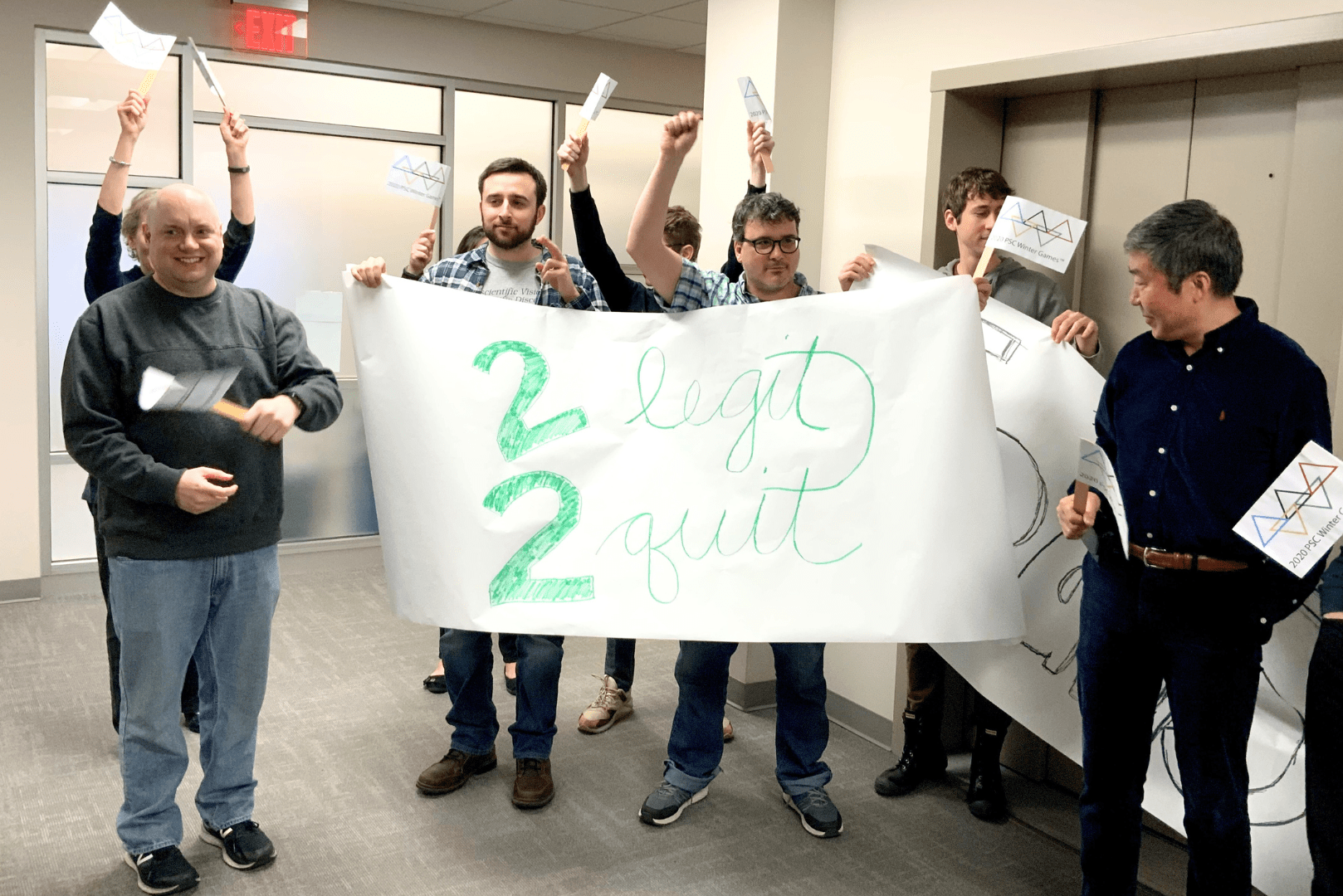
Rob, far left: 2 legit 2 quit during a server crash, and 2 legit 2 quit at the annual PSC Winter Games.
CC: Wow! I think everybody’s been through something like that. Moving on to when you started hiring folks, what was that like?
RL: Hmm… it’s definitely interesting being on the other side of it. You know, going through interviews and realizing how hard it is to determine what skills people actually have versus what’s on their resume.
CC: Does PSC ask candidates to complete an exercise when hiring for technical positions?
RL: We’ve added that now where we send them a programming assignment and they send it back to us. Now our concern is that they can just feed it into an AI maybe? We’ll have to figure that out as we go.
CC: That’s hard to compensate for. So, who are some of the folks at PSC that you have hired, if you wouldn’t mind sharing?
RL: I hired Sunset, Gesina, Matt, and Asim, I think those are the latest since I’ve been a manager. There’s also Juan and Burt in my group, but they were hired before. I think Shawn [Brown] hired him. (Since the interview…) we hired Eva and Keaton who work 50% for me and 50% for Ken Hackworth.
CC: Any funny anecdotes from when you hired any of those folks?
RL: I can’t really think of anything. I felt bad for Matt because he started just a week after I had knee surgery. I was pretty useless, at the time, and basically just pointed to some documents and said you’re gonna have to figure this out yourself, for a little while, anyway.
CC: Things often go that way. At PSC, there’s always somebody, even if you have a special skillset, who has your back and will help, especially when you’re new. In your PSC career, what have been the most interesting or challenging aspects?
RL: I’d say one of the most challenging things has been how the funding has changed over the years. I feel like there used to be less projects that had more funding, and now we have so many more projects here, but they have less funding. You know, we just have more and you have less time on all of them. Which is definitely challenging.
CC: I’ve not been here very long, but I can attest to that.
RL: And you’ve got to wear a lot of hats here, too.
CC: This is not a place where most people do only one thing.
RL: At times, it’s nice, when I think about something else and there’s lots of things you can think about if you need a break. It helps break up your day or your week.
CC: Is there anything else you would like to share on your time here at PSC or any particular projects?
RL: I was just thinking back to when I was on staff, but we used to have a lot more interns than we have now. We were over in Mellon Institute and we had this big office.
It was down the floor from where I was, but we had a whole bunch of interns all sharing that office and when you went down there, you went to have a little bit of fun.
CC: Oh yeah?
RL: It was. They had a dart board down there that used sticky darts that would stick to almost anything. Of course, we ended up with sticky darts stuck everywhere, some stuck to the ceiling that stayed up there for years! No one could reach them!
CC: That place has tall ceilings, some of those rooms in Mellon Institute.
RL: Yeah, colossal.
CC: It’s surprising to hear that in the past there were a lot more interns. We seem to have quite a few come through sometimes.
RL: Yeah, we still have a good many during the summer time here. We used to have them during the academic year.They would work 20 hours during the school year and then 40 hours during the summer.
CC: Interesting.
RL: And our group had a lot of time too. So it was like a whole extra team, very fun.
CC: Interns – they bring new insights to PSC. We all have our own way of doing things, but these students come with fresh ideas. Thanks, Rob, I appreciate your time.
RL: Yep, see you around.