

2002 Simulation of Aquaporin Protein Showed How Cells Maintain Balance Needed for Healthy Functions
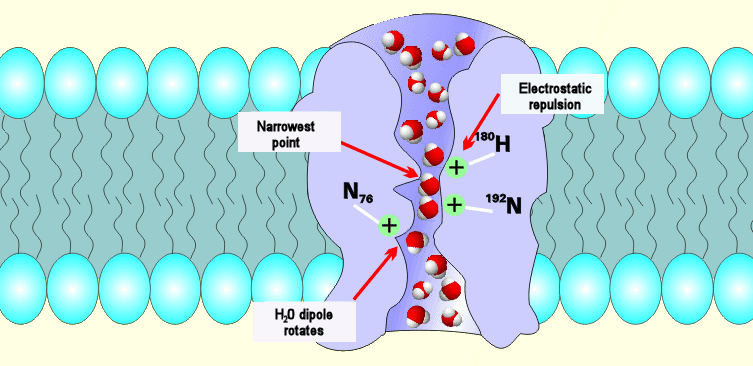
Our bodies’ cells must allow water to cross their membranes while maintaining strategic imbalances of other molecules. In 2002, scientists were puzzled by how the protein channel aquaporin allows water molecules to pass through cell membranes without letting hydrogen ions — basically, dilute acid normally present outside the cell — travel along with them. A simulation on Lemieux at PSC, then the fastest supercomputer in the world for open research, allowed a team from the University of Illinois to identify a pirouette by each water molecule flowing through the channel. This closed the door to acid while allowing water free travel.

PSC40: Powering Discovery
2026 marks 40 years of PSC. As we continue on with cutting-edge innovation, we look back on four decades of history in computing, education, and groundbreaking research—and the people who made it happen.

WHY IT’S IMPORTANT
Our bodies are, famously, 60 percent water. Despite that, or maybe because of it, managing water is a major biological problem. When we get hot, we lose water to sweat. When we get cold, we lose water both to breathing it out and to the kidneys dumping it into urine.
Achieving the balance of water within our cells is even trickier. For many of our cells, the play is to let the water pass through their membranes but to keep close control of other molecules. Cells in our body, for example, need to have more potassium inside and more sodium outside. It’s also common for cells to be slightly more acidic outside, more basic inside.
How cells achieve that last one puzzled scientists for some time.
Water becomes more acidic when positively charged hydrogen ions (H+) outnumber negatively charged hydroxyl ions (OH–). In neutral water, the two combine to create neutrally charged water molecules (H2O), and so few of either are around. When an acid is introduced to the water, like vinegar, it adds hydrogen ions.
But hydrogen ions don’t really exist as naked H+. They tend to glom onto a water molecule, forming what’s known as hydronium — H3O+, or a water with an additional, positively charged hydrogen stuck to its oxygen atom.
That last part was the problem. Scientists knew that the channel protein aquaporin allows water to flow freely across cell membranes. Cells whose membranes can allow a lot of water to pass, like kidney cells, do so because they have more aquaporin. But aquaporin does not allow hydrogen ions through. Which was a mystery, since hydrogen ions can hop from water molecule to water molecule, like electricity flowing through a wire. In the central pore of aquaporin, a chain of water molecules passing through should let hydrogen ions through. But it doesn’t.
In 2002, scientists knew what aquaporin looked like, thanks to work by researchers at the University of California, San Francisco. That protein structure clearly showed the channel that the water molecules use to pass through the membrane. But this static structure didn’t cast any light on how aquaporin excluded hydrogen ions. The University of Illinois’s Klaus Schulten realized that, to identify how aquaporin worked, we would need to see the protein in motion. Using the static structure of aquaporin as a starting point, he’d need to simulate the movement of water molecules through the channel. The tool he used for that task was PSC’s then-flagship Terascale Computing System, nicknamed Lemieux.
HOW PSC HELPED
In a lot of ways, Lemieux was as dominating among other supercomputers as its namesake was among hockey players. When PSC first powered it up, it was the most powerful supercomputer in the world dedicated to non-proprietary and non-classified research. Its 2,440 processors were capable of tackling a massive problem like simulating water moving through a wiggling aquaporin protein by breaking it up into many small pieces that could be computed in parallel.
In one of the earliest simulations of its kind, Schulten’s team created a virtual aquaporin in the computer. This simulated protein sat in a membrane made of realistically moving components and surrounded by water molecules, which could then move through the channel.
The sim had a surprise ending. Instead of moving through the channel like a line of cars going through a tollgate, the water molecules did a flip half-way through. They began with their oxygen molecule pointing forward, then rotated so that their two hydrogens were in the lead. This pirouette neatly explained how hydrogen ions couldn’t get through — the flip prevented the ions from passing from the water molecule on either side of the turn. Schulten and his crew published their results in the prestigious journal Science in April 2002. The work also contributed to the 2003 Nobel Prize in Chemistry.
Thanks to such early successes, today molecular dynamics simulations are relatively common. PSC’s flagship Bridges-2 system, like Lemieux, is strong at simulating the largest biomolecular systems. A third-generation Anton supercomputer, developed by D. E. Shaw Research and hosted at the center, also specializes in simulating biomolecules on timescales that are well beyond the reach of general-purpose supercomputers.