
Record-setting Thermal Conductivity Improves on Metals’ Electron-Based Conductivity, Helping Smaller Devices Dump Heat
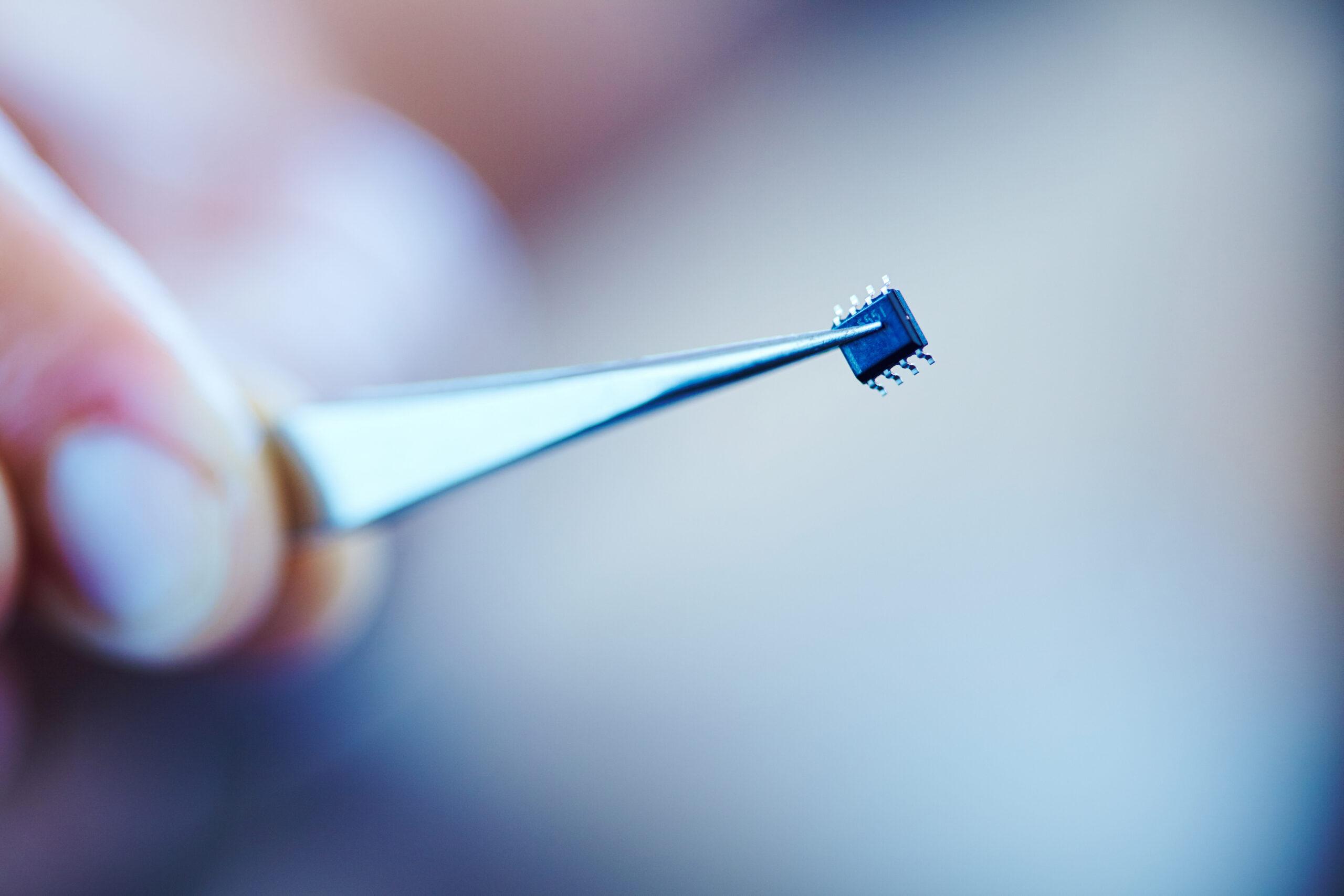
Smaller, faster devices are having more and more trouble dumping the heat they generate. Copper has long been the “gold standard” for conducting heat away from a device. But metals’ thermal conductivity is limited by their physics. A multi-institutional team led from the University of California, Los Angeles, used PSC’s flagship Bridges-2 to simulate a new metallic material that, when created and tested in a real-world lab, had nearly three times as much thermal conductivity as copper.
WHY IT’S IMPORTANT
In the race to develop smaller and smarter electronics, heat is a major stumbling block. The smaller our devices get, the harder it is to get the heat they generate out, so that they don’t cook themselves. Copper has long been the champ at thermal conductivity, carrying heat away at what has been respectable roughly 400 Watts per meter Kelvin.
Problem is, we’ve now gotten to devices small enough that 400 W/mK just isn’t enough. We desperately need materials that can draw heat out of electronics more effectively than that.
Metals like copper carry heat away mostly via their electrons. By definition, metals are metals because they’re surrounded by a soup of these electrically charged particles. This soup also conducts heat. The process is efficient, but limited by the physics of electrons. At a certain point, electrons start scattering the heat energy within the material rather than conducting it out.
“One of our group’s previous successes was back in 2018, [when] we published a paper discovering a crystal called boron arsenide, which [has] the highest thermal conductivity of all the semiconductors … Copper, which is considered to be the best practical thermal conductor in metallic materials, takes around 30 percent of the global market in terms of thermal management. So we started to think about how to make another breakthrough, or at least improve thermal management [compared with] using metallic materials …”
— Chuanjin Su, UCLA
A glimmer of hope came from the relatively high thermal conductivity of semiconductors like boron arsenide. These are not metals, and don’t have the soup of electrons to carry heat. Instead, they trade heat via a type of quasi-particle called phonons.
Phonons don’t actually exist as physical objects. Instead, they’re a kind of vibration, sort of like a sound wave, that acts like a particle. In semiconductors and insulators, they carry heat away as if they were physical particles. But as they’re not physical matter and as they don’t carry the electron’s charge, they’re not limited in a similar way. Boron arsenide, for example, actually conducts heat much better than copper, proving that phonons can definitely beat electrons at the thermal conductivity game.
Suixuan Li, Chuanjin Su, and Zihao Qin, graduate students working in the lab of Professor Yongjie Hu at UCLA’s Department of Mechanical and Aerospace Engineering, wanted to know whether they could create a metallic compound whose phonons could beat copper’s electrons at carrying heat away. One of the first steps in their multi-institutional work, led by Hu, was to simulate their candidate materials on PSC’s NSF-funded Bridges-2 supercomputer.
HOW PSC HELPED
The team knew that simulating the behavior of a material and its phonons from first principles would be the most promising way forward. In particular, they want a material whose phonons didn’t interact too much with each other, so that they wouldn’t scatter heat the way that electrons would. They’d also need the phonons not to interact too much with the electrons that every metallic compound has, because that would also lead to scattering and inefficient heat conduction.
To prove that the simulations were capturing real-world behavior, they developed a collaboration with colleagues at Argonne National Laboratory, Lawrence Berkeley National Laboratory, the Institute of Multidisciplinary Research for Advanced Material in Japan, the Irvine Materials Research Institute, and California NanoSystems Institute. These collaborators would help by creating the materials in the lab, testing them, and measuring their thermal conductivity. In a ping-pong game between the computer and the real world, the scientists then would go back to Bridges-2 and refine their predictions until they had a physical material that showed the performance they wanted.
“At the first stage, we used Bridges-2 to make predictions and analysis [of the material’s behavior] … But later on, the major task became figuring out the physics behind the ultra-high thermal conductivity… So, in that period, our main focus was to find the converging point where our calculations and experiments confirmed each other… And Bridges-2 has super-powerful resources so I could do the calculations really quickly. Also [it] has all the major software that I need.”
— Chuanjin Su, UCLA
Such calculations are computationally expensive. The collaborators would need to build a simulated material from ground-truth knowledge, putting many tiny steps together to create something large enough for its behavior to be measured. Bridges-2’s 504 regular memory nodes, with between 256 and 512 gigabytes of memory each, offer more than 64,000 computational cores. (Compare its total 133,000 GB of memory to 32 GB, and 10 cores, for a hot laptop.) This gives Bridges-2 the power necessary to crunch these tiny steps in a reasonable amount of time.
The UCLA-led team found that a material called theta-phase tantalum nitride (θ-TaN) showed exactly the kind of phonon behavior they were after. Working on a tiny crystal of θ-TaN in a real-world laboratory, they measured a thermal conductivity of about 1,100 W/mK — almost three times as much as copper! They published their results in the prestigious journal Science in January 2026.
The team continues to study θ-TaN and related compounds, both to see whether even better thermal conductivities are possible and to further understand how phonon interactions allow it to conduct heat so much better than copper. More discoveries on the basic science behind phonon behavior could help them pave the way for even more effective, ready-for-prime-time materials to carry heat out of new electronics.